
 Enquire Now






 28 October, 2026| by Admin


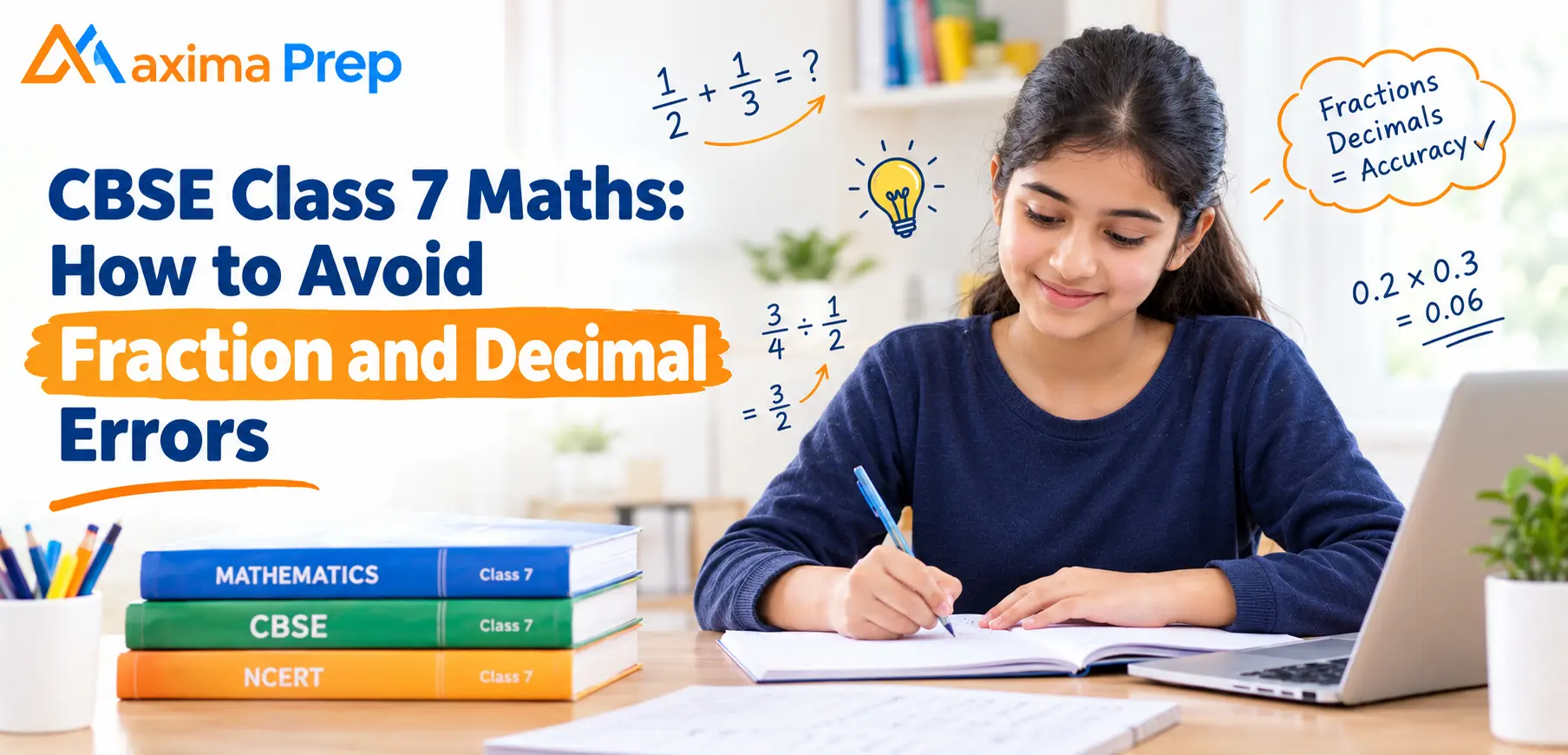


A small calculation error can change a correct Maths answer into a wrong one. For CBSE Class 7 students, fractions and decimals often become tricky when a question involves different operations, decimal points, or multiple steps. However, students can overcome these challenges by understanding the rules and practising them regularly. A well-structured CBSE online course India can also help students strengthen their basic Math skills and solve problems with greater confidence. The key is to learn why a method works instead of memorising every step. In this blog, we will discuss common mistakes in fractions and decimals and explain how students can avoid them.
Top Mistakes Students Make When Solving Fractions and Decimals
Here are the most common mistakes students make when solving fractions and decimals.
-
Adding Fractions without Finding a Common Denominator
The first common mistake students make when solving fractions and decimals is adding fractions without finding a common denominator. Students often add the numerators and denominators directly. This method gives the wrong answer when the fractions have different denominators.
Example:
Incorrect: 1/2 + 1/3 = 2/5
Correct: 1/2 + 1/3 = 3/6 + 2/6 = ⅚
How to avoid this mistake: Find a common denominator before adding or subtracting fractions. You can use the LCM of the denominators to make the calculation easier.
-
Forgetting to Simplify Fractions
Another very prominent mistake students make is forgetting to simplify fractions. A fraction may have the correct value but still need simplification. For example, students may write 4/8 instead of 1/2.
How to avoid this mistake: Divide both the numerator and denominator by their common factor. Always check whether you can reduce the final answer to its simplest form.
-
Confusing Multiplication and Division Rules
We all know that multiplying and dividing fractions follow different steps. During division, students sometimes forget to take the reciprocal of the second fraction.
Example:
3/4 ÷ 1/2 = 3/4 × 2/1 = 6/4 = 3/2
How to avoid this mistake: For fraction division, keep the first fraction unchanged, change division to multiplication, and invert the second fraction.
-
Placing Decimal Points Incorrectly
Placing decimal points incorrectly is another common mistake students make when solving fraction and decimal problems. Decimal multiplication often confuses students. They may multiply the numbers correctly but place the decimal point in the wrong position.
Example:
0.2 × 0.3 = 0.06, not 0.6.
How to avoid this mistake: To avoid this mistake, multiply the numbers first. Then count the total decimal places in both factors and place the decimal point correctly in the answer.
-
Ignoring Zeroes and Place Value
Zeroes can change a decimal’s value depending on their position. Students may also confuse tenths with hundredths. For example, 0.5 equals 0.50, but it does not equal 0.05.
How to avoid this mistake: Understand the value of each digit after the decimal point. Practise reading, comparing, and arranging decimal numbers in order.
How to Improve Accuracy in Class 7 Maths
Students can improve their performance by following a few simple habits:
- Practise a few fractions and decimal problems every day.
- Show each calculation step instead of rushing to the answer.
- Check the signs, decimal points, and units where needed.
- Solve NCERT textbook exercises before moving to harder questions.
- Review wrong answers and understand the reason behind each mistake.
The Conclusion
Fractions and decimals become easier when students understand the rules and apply them with care. Hence, regular practice can improve accuracy, speed, and confidence in Maths.
So, help your child build a stronger foundation in Mathematics with Maxima Prep! Maxima Prep offers online CBSE tuition for Classes 6-10, with experienced teachers, flexible learning schedules, and customised learning plans. Our Maths classes help students understand difficult concepts, practise problem-solving, and build confidence. Contact Maxima Prep, a renowned CBSE online coaching service, and book a free demo class to help your child build stronger Maths skills.
No previous post

Next Post
Categories
CBSE Class 7 Maths
CBSE Class 7 Maths Practice
CBSE Mathematics Coaching
Fractions and Decimals Class 7
How to Avoid Calculation Errors