
 Enquire Now






 07 November, 2026| by Admin


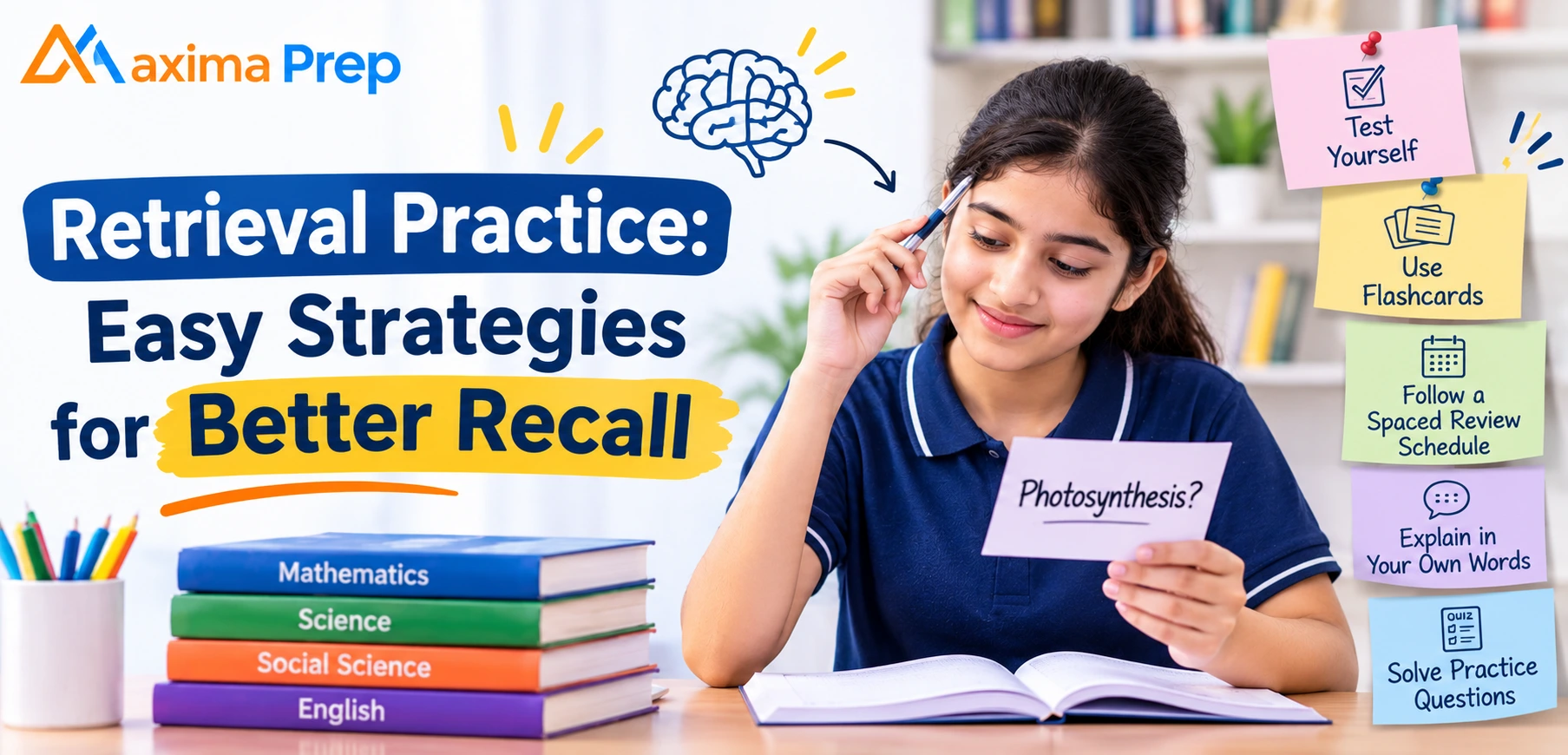


Forgetting a lesson soon after studying can feel frustrating, especially as exams approach. However, remembering information is not just about how many hours students spend with their books. It also depends on how they revise and use their knowledge. Reading a chapter several times may help students recognise information. However, recalling it without looking at the textbook can build stronger memories.
This is where retrieval practice becomes useful. It turns revision into an active learning process and helps students remember concepts for longer. Students looking for the best CBSE online coaching India can also benefit from learning methods that encourage active recall. In this blog, we will highlight how retrieval practice works, its benefits and simple ways students can use it in their daily studies.
What is Retrieval Practice and How Does It Improve Memory?
Retrieval practice is a study technique that encourages students to recall information from memory. This technique helps students avoid reading a chapter repeatedly. It can also help the brain strengthen connections to previously learned information.
For example, after studying a Science chapter on the human digestive system, a student can close the textbook and try to explain the process from memory.
A research review published in Educational Psychology Review in 2021 examined 50 classroom experiments involving 5,374 participants. The researchers found that retrieval practice improved learning across different subjects and educational settings.
5 Effective Ways to Use Retrieval Practice for Better Learning
Students can include retrieval practice in their daily study routine without spending extra hours on revision. Here are five simple methods to try when practising retrieval.
-
Test Yourself After Every Study Session
The first prominent step of using retrieval practice is to test yourself after every lesson. Instead of reading the same lesson repeatedly, you should close your textbooks and try to recall what you have learned. You can write down the main points, answer questions without checking your notes and identify concepts you find difficult. After completing the exercise, check the answers and correct any mistakes. This simple habit can help you understand how much you have actually learned and which topics need more attention.
-
Create Flashcards for Quick Revision
Another very effective way to use retrieval practice is to create flashcards. Flashcards make learning simple and interesting. Students can write a question on one side and its answer on the other. For example, they can write “What is photosynthesis?” on one side and “The process by which green plants make food using sunlight” on the other. Flashcards are useful for revising scientific terms, mathematical formulas, historical dates and English vocabulary. They also make quick revision easier before school tests and examinations.
-
Follow a Spaced Revision Schedule
Following a spaced revision schedule is another notable step of using retrieval practice. Studying a topic once may not help students remember it for months. They should recall the same information at regular intervals. For example,
- Day 1: Learn the topic and recall the main points.
- Day 2-3: Test yourself again.
- Day 4-6: Answer questions without notes.
- Day 7: Take a short revision test.
Remember, combining retrieval practice with spaced revision can support long-term memory.
-
Explain Concepts in Your Own Words
Teaching someone else is another useful way to practise recall. Students can explain a lesson to their parents, friends or even themselves. For instance, explaining fractions through examples of sharing a pizza can make Mathematics easier to understand.
-
Solve Practice Questions and Quizzes
If you want to master retrieval practice, solve questions and quizzes on a regular basis. Regular quizzes can help students recall information and prepare for examinations. They can also help identify weak areas. However, students should check their answers after every quiz. Understanding mistakes is just as important as answering questions correctly.
Common Retrieval Practice Mistakes to Avoid
To get better results, always try to avoid the habits mentioned below:
- Looking at notes while answering every question.
- Memorising answers without understanding concepts.
- Revising only before examinations.
- Ignoring mistakes during practice tests.
- Trying to recall too much information in one session.
The Conclusion
Remembering concepts for longer requires regular practice, active revision and proper guidance. With the right study habits, students can improve memory and develop confidence. At Maxima Prep, we offer online tuition for CBSE Classes 6-10 in Mathematics, Science, English and Social Science. Our experienced teachers, customised learning plans, interactive lessons and regular assessments can help students strengthen concepts at their own pace. Want to book a free demo class? Contact Maxima Prep, a renowned online tutor service India today to make learning more effective and build a stronger academic foundation.
No previous post

Next Post
Categories
Better Recall and Learning Strategies
Effective Study Techniques for CBSE Students
Memory Improvement Techniques
Retrieval Practice Techniques
Spaced Revision Techniques