
 Enquire Now







 07 July, 2026| by Admin


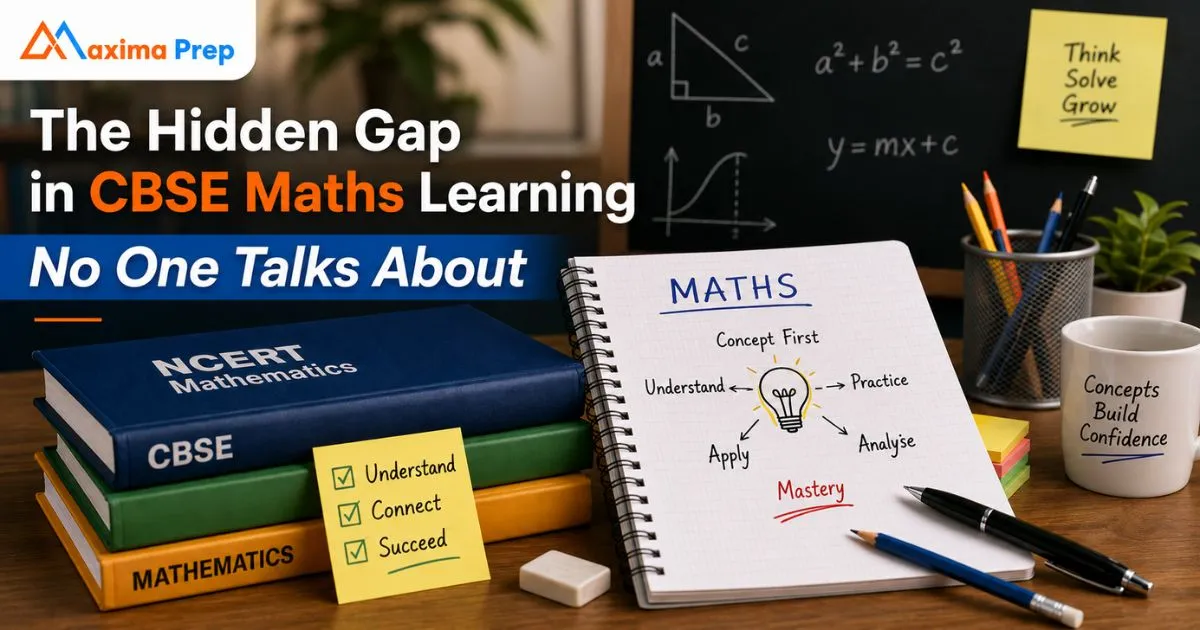


Often known as the language of reasoning, Mathematics lays the foundation for logical thinking. In the CBSE curriculum, Mathematics is much more than just a scoring subject. It develops analytical thinking, reasoning ability, and problem-solving skills that students carry throughout their academic and professional lives. Over the past few years, CBSE has also shifted its focus from rote learning to competency-based education. This encourages students to apply concepts instead of simply recalling formulas. Yet despite these changes, many students continue to struggle with Maths, even after practising for hours.
Do you know why this happens? The problem is not always difficult chapters, lengthy calculations, or a lack of practice. Many of us are not aware that a hidden learning gap quietly develops when students focus only on completing exercises instead of understanding the concepts behind them. This gap often goes unnoticed until examinations introduce higher-order thinking or application-based questions.
The increasing popularity of CBSE online study has given students greater flexibility to learn at their own pace. However, meaningful progress still depends on building conceptual clarity instead of relying on rote learning. In this blog, we will discuss the hidden gap in CBSE Maths learning and explore practical ways to develop stronger mathematical insight for long-term academic success.
Why Understanding Matters More than Memorising in CBSE Maths
Here’s what makes conceptual learning the real key to success in CBSE Mathematics.
Concepts Come Before Formulas
We all know that Mathematics follows logic. Yet many students prepare by memorising formulas and repeatedly solving similar questions. This approach may work for routine exercises, but it fails when CBSE introduces application-based or competency-focused questions. Without understanding the “why” behind a method, students can find it difficult to solve unfamiliar problems.
Why Fear of Mistakes Slows Progress
Many students stop asking questions because they fear being judged. This hesitation can create a silent learning gap. When doubts remain unresolved, even simple concepts become confusing over time. Mathematics is a subject that gains ground chapter by chapter. Hence, one weak foundation can impact every topic that follows.
Practice Alone Doesn’t Build Mastery
Many students solve dozens of questions every day, but very few can assess their mistakes. Simply completing worksheets does not guarantee progress. Students also need to understand where they went wrong, why the mistake happened, and how to avoid repeating it. This habit can strengthen mathematical thinking instead of mechanical problem-solving.
Real-life Application Receives Less Attention
Many of us are unaware that CBSE has gradually shifted towards competency-based education. Questions now test reasoning, interpretation, and analytical skills instead of direct formula recall. Hence, students who only depend on textbook patterns often struggle in the exam. It’s because they have not connected mathematical concepts with practical situations.
Every Student Learns at a Different Pace
Every child learns at a different pace. Some grasp algebra quickly but need extra support in geometry. Others may understand concepts only after visual explanations or interactive discussions. Unfortunately, many classrooms cannot always provide personalised attention, allowing learning gaps to grow unnoticed.
Confidence Begins with Conceptual Clarity
Parents and students often focus only on test scores. However, confidence develops when a student genuinely understands concepts and solves problems independently. A strong conceptual foundation can reduce exam anxiety and encourage curiosity, making Mathematics far less intimidating.
Small Revision Habits Create Big Results
Many students often postpone revision until exams approach. By then, forgotten concepts become difficult to recover. Short, consistent revision sessions can, therefore, help strengthen memory, improve accuracy, and connect previously learned topics with new concepts.
The Conclusion
So, the hidden gap in CBSE Maths learning is not about intelligence or hard work. It lies in the difference between memorising solutions and truly understanding mathematical concepts. Once students bridge this gap, they can become more confident, solve problems creatively, and perform better in school as well as competitive examinations. We at Maxima Prep are committed to supporting students with quality educational solutions designed for modern CBSE learning. Contact Maxima Prep, a leading online tutor service, today and help your child transform Mathematics from a challenging subject into a lifelong strength.
Categories
CBSE Learning
CBSE Mathematics
CBSE Maths Learning
Maths Learning Tips